Reopening the Case Against Lang Darma
Tri Udum Tsenpo (khri ’u dum btsan po; r. 841–842), better known to posterity as Lang Darma, remains one of the most misunderstood figures in Tibetan history. The epithet itself is telling: lang (glang) in Tibetan means ox or bull, and the image of a horned, devil-like beast was no accident. It was a characterization carefully constructed by later historiography. The villainization of Udum Tsenpo offers a striking case study in how history is written by the victors, and how the narrativization of the past shapes what gets remembered, what gets distorted, and whose interests are served in the process.
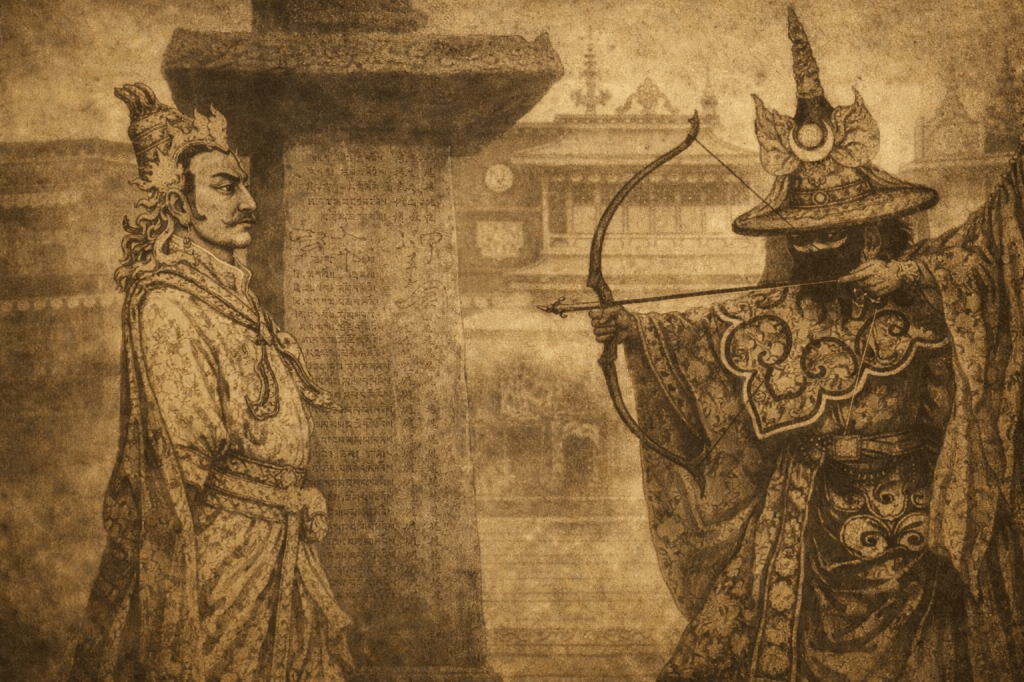
According to the dominant narrative preserved in post-imperial Tibetan historiography, Lang Darma systematically destroyed Buddhist monasteries, persecuted the clergy, and colluded with ministers hostile to Dharma (blon po chos la gnag pa) at court to bring about the decline of Buddhism in Tibet. According to this narrative, it was a Buddhist monk who put an end to it. Lhalung Pelgyi Dorje, armed with a bow and arrow concealed beneath his long black cloak, approached the emperor under the pretense of performing a ritual dance.1 He shot the Tsenpo at close range and fled on a white horse he had blackened with charcoal. Crossing a river washed the horse clean, and the reversal of his cloak revealed a white lining, a miraculous transformation that allowed him to escape undetected to Eastern Tibet.2
However, the contemporary record tells a different story. Not a single ninth-century document corroborates the tale of systematic persecution. The Dunhuang manuscripts, which contain a remarkable range of Tibetan imperial-period documents, present no record of a systematic persecution of Buddhism or purge of Buddhists.3 The Old Tibetan Annals, the most reliable of the imperial period, make no such case against the last emperor. Tang dynasty sources, which documented Tibetan affairs closely given the two empires’ sustained political and military contact, are equally silent. The anti-Buddhist persecution narrative appears only in later sources, earliest among them the Testament of Ba (dBa’ bzhed).
What the contemporary record does preserve is a picture of an imperial court under severe institutional strain. Under Lang Darma’s brother and predecessor, Tri Tsug Detsen (r. 815–841), popularly known as Tri Ralpachen, the Buddhist establishment and clergy had accumulated extraordinary power. Decrees required seven households to support a single monk. Ralpachen’s religious expenditure is thought to have contributed to a fiscal crisis.4 The most influential figures at the imperial court were clerics, among them the monk-minister Nyang Ting-ngé dzin. Massive state-sponsored translation projects consumed imperial resources on a scale that generated resentment among court factions, particularly those aligned with the Bon tradition. Lang Darma’s attempts to curtail clerical power are better understood as a pragmatic political effort to rebalance a court tilted dangerously toward Buddhist institutional interests. As the empire’s fiscal base eroded, the ‘Seven Households’ decree transformed from a pious gesture into a socio-economic chokehold. By framing Lang Darma’s fiscal reforms as ‘persecution,’ later historians successfully reframed a state bankruptcy as a cosmic battle between good and evil.
As Samten Karmay has argued, there is no clear evidence that Lang Darma persecuted Buddhism as such; rather, he may have closed monasteries for economic reasons arising from an institutional crisis, driven by opposition to the growing political power and economic privileges of Buddhist institutions rather than hostility to the faith itself. 5 While the powerful clans like that of Ba and Nyang (Myang) were pro-Buddhist aristocrats, other older clans like Chim (mChims) supported ancestral cults as the source of political authority for the Tibetan imperial state.6 Wangdu and Diemberger argue that: “These conflicting elements became intertwined and shaped the alliances and the rivalries between clans and their relation to the royal house.”7 There is also evidence that the sons of the Ba and Chogro (Cog ro) clans dominated the abbatial seat of Samye Monastery in the late eighth and ninth centuries, a pattern that reflects perennial aristocratic competition and the consolidation of religious authority as a characteristic feature of Tibetan social life throughout its history.
Interestingly, the Testament of Ba with an Addendum (Sba bzhed zhabs brtags ma, 13th–14th century) attributes the widespread storms and severe famine of the period to hostility toward Buddhism, presenting these calamities as the result of a cosmic disorder triggered by the rejection of Śākyamuni and the ensuing conflict among the gods.8 Although this work was composed several centuries after the collapse of the Tibetan Empire, its reference to widespread storms and famine, interpreted as the result of religious transgression, nonetheless points to the possible role of climatic stress in exacerbating the empire’s economic fragility in its final phase.
The state of Buddhism at the court of the Tang Dynasty (618–907 CE) offers a compelling parallel. The Tang court faced a structurally similar problem: imperial patronage for Buddhist cultural production had grown to a point of unsustainability, generating backlash from Confucian officials and contributing to broader fiscal and political instability. The suppression of Buddhism under Emperor Wuzong (r. 840–846), known as the Huichang Persecution of Buddhism (842–845), coincided closely with the collapse of the Tibetan Empire. This campaign was motivated in large part by the accumulation of tax-exempt land by monasteries and clergy, which undermined the fiscal base of the state and contributed to mounting economic pressures.9 In the succeeding Song dynasty, Confucianism was revived as the dominant political philosophy and Buddhism lost its central role at court, never recovering the political influence it had enjoyed under the Tang. This pattern suggests that the tension between imperial authority and an overextended Buddhist establishment was not unique to Tibet but a structural feature of Buddhist polities across Asia in this period.
There is, to date, no clear evidence supporting the claim that Lang Darma persecuted Buddhism; on the contrary, there is evidence suggesting that he supported Buddhist institutions. Old Tibetan documents from Dunhuang indicate that temples were constructed during his reign, and prayers were composed for the emperor Udum Tsenpo.10 The transformation of Lang Darma into a horned demon, and of his assassin into a hero, thus reveals much about the priorities of post-imperial Tibetan historiography and the broader evolution of national mythmaking. Crucially, this narrative also obfuscated the material catalysts of the crisis, both economic and ecological. Thus, Tibetan monastic historians manufactured a villain out of Lang Darma; he was not found to be an enemy of the faith, but was created as one to provide a moral alibi for an ecologically and economically failing empire.
Reference
Ch’en, Kenneth. “The Economic Background of the Hui-Ch’ang Suppression of Buddhism.” Harvard Journal of Asiatic Studies 19, no. 1/2 (1956): 67–105.
Doney, Lewis. “The Degraded Emperor: Theoretical Reflections on the Upstaging of a Bodhisattva King.” Revue d’Etudes Tibétaines 49 (2019): 13–66.
Dotson, Brandon. The Old Tibetan Annals: An Annotated Translation of Tibet’s First History, with an Annotated Cartographical Documentation by Guntram Hazod. Vienna: Verlag der Österreichischen Akademie der Wissenschaften, 2010.
Karmay, Samten G. The Arrow and the Spindle: Studies in History, Myths, Rituals and Beliefs in Tibet. Vol. 1. Kathmandu: Mandala Book Point, 1988.
Mandelbaum, Arthur. “Lhalung Pelgyi Dorje.” Treasury of Lives. Accessed March 23, 2026. http://treasuryoflives.org/biographies/view/Lhalung-Pelgyi-Dorje/9618.
van Schaik, Sam. “Tibetan Buddhism in Central Asia: Geopolitics and Group Dynamics.” In Transfer of Buddhism across Central Asian Networks (7th to 13th Centuries), edited by C. Meinert, 57–81. Leiden: Brill, 2006.
Footnotes
- Arthur Mandelbaum, “Lhalung Pelgyi Dorje,” Treasury of Lives, accessed March 23, 2026, http://treasuryoflives.org/biographies/view/Lhalung-Pelgyi-Dorje/9618 ↩︎
- Pawo Tsuklak Trengwa (dPa’ bo gTsug lag phreng ba). Chos ’byung mkhas pa’i dga’ ston (The Feast of Scholars). Mi rigs dpe skrun khang, 2006 [1476]: 223–224. Also see Kapstein, 2006: 80-81. ↩︎
- Recent scholarship has increasingly engaged in a critical reassessment of earlier narrative constructions of Tibetan Buddhist historiography. See Lewis Doney, “The Degraded Emperor: Theoretical Reflections on the Upstaging of a Bodhisattva King.” Revue d’Etudes Tibétaines 49 (2019): 20.
↩︎ - Kapstein, The Tibetans, 2006: 79. ↩︎
- Samten G. Karmay, The Arrow and the Spindle: Studies in History, Myths, Rituals and Beliefs in Tibet. Vol. 1. Kathmandu: Mandala Book Point, 1988: 8-9. ↩︎
- Powerful clans such as the Nyang and Ba had earlier, during the time of Namri Songtsen, revolted against their ruler Zingpoje, the king of Phanyul, and subsequently formed an alliance with the Pugyal (Yarlung) king. ↩︎
- Pasang Wangdu and Hildegard Diemberger. dBa’ bzhed: The Royal Narrative Concerning the Bringing of the Buddha’s Doctrine to Tibet. (Vienna: Austrian Academy of Sciences Press), 2000: 7. ↩︎
- “At that time in Lhasa there were frost, hail, famine, human disease, and livestock disease. The emperor, having investigated the matter, addressed all his subjects: ‘In Lhasa there have arisen human diseases and the like—what is the cause of this?’ When he asked, they replied that they did not know. [Then it was said:] ‘I know: a harmful female spirit called Gyakongjo brought an inauspicious god of the harmful spirits, called Śākyamuni. Having brought him to the summit of Mount Meru, she caused conflict among the gods, defeated them, and brought about their destruction.” (dus der lha sar sad dang btsa’ dang / mu ge mi nad phyugs nad byung bas / de la btsan pos bsnyad byas nas / ‘bangs kun la lha sar mi nad la sogs pa byung / ‘di cis lan shes sam dris pas / mi shes zer / ngas shes te rgya kong jo bya ba’i gnod sbyin mo gcig gis gnod sbyin gyi lha shAkya mu ne zer ba bkra ma shis pa gcig spyan drangs nas / ri rab kyi rtse mor ‘ongs nas lha ‘khrug pa pham par byas nas lha phung bar byas). sba bzhed zhabs btags ma. The reference to the Chinese consort and her statue of Śākyamuni, brought from China and portrayed as an ominous symbol of foreign influence and a source of destruction, reflects Darma’s perception of Chinese Buddhism as a significant phenomenon of the time. ↩︎
- Kenneth Ch’en. “The Economic Background of The Hui-Ch’ang Suppression of Buddhism.” Harvard Journal of Asiatic Studies 19, no. 1/2 (1956): 105. ↩︎
- Brandon Dotson. The Old Tibetan Annals: An Annotated Translation of Tibet’s First History, with an Annotated Cartographical Documentation by Guntram Hazod (Vienna: Verlag der Österreichischen Akademie der Wissenschaften, 2010), 21. ↩︎
 Tibet Historica
Leave a comment