Book Note 01
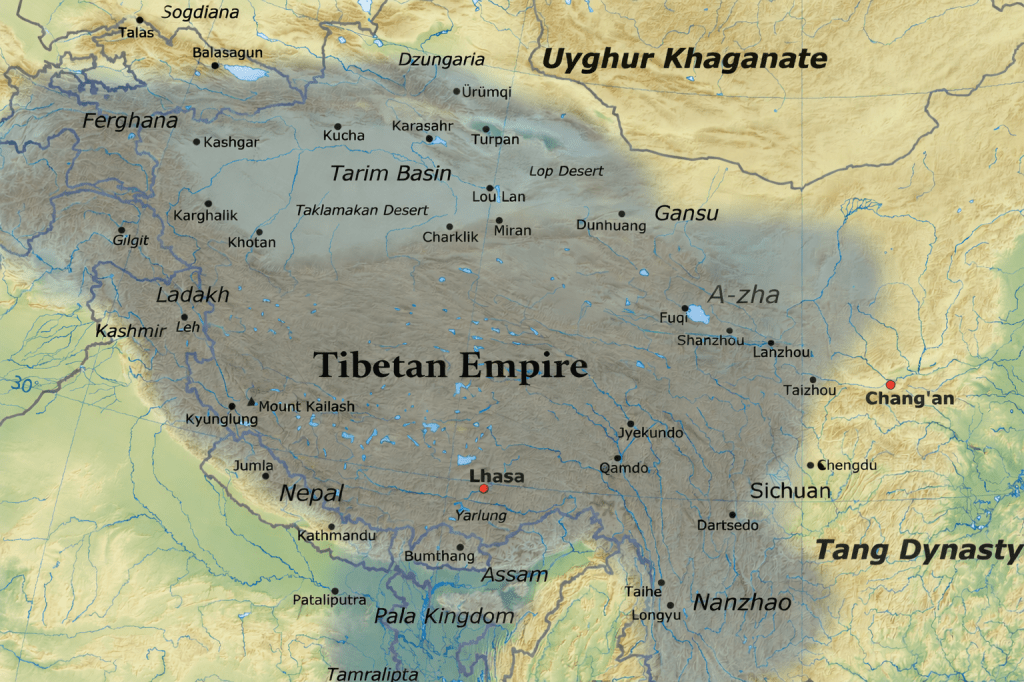
Did you know that in 763, Tibetan forces marched into Chang’an, the imperial capital of Tang China, installed a puppet emperor, and held the city for fifteen days? Emperor Daizong fled the city. It was a feat no Inner Asian power had managed before and few would match after. Unlike the Mongols in the thirteenth century or the Manchus in the seventeenth, they had no desire to rule or absorb China into their empire, but they were happy to dictate who sat on its throne.
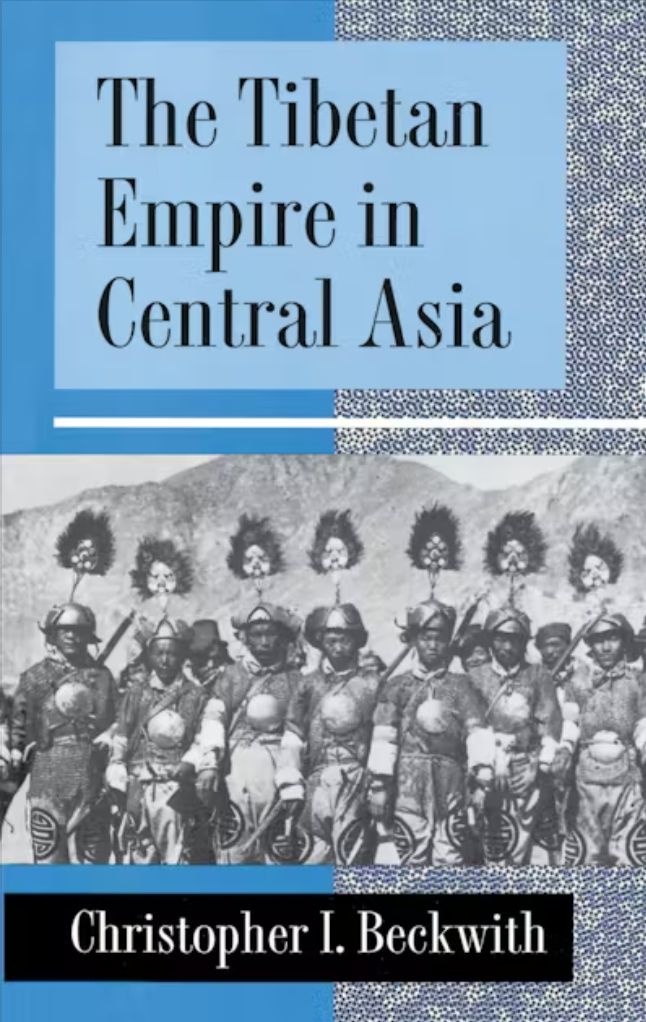
Yet the empire that once humbled the Tang and stretched from the Tarim Basin to Bengal and controlled the arteries of the Silk Road has been persistently sidelined in histories of the early medieval world. Christopher I. Beckwith’s The Tibetan Empire in Central Asia (1987)1 offers a long-overdue corrective. Drawing on a wide range of multilingual sources, Beckwith reconstructs a formidable expansionist state that emerged as a central actor in the contest for the Silk Road, rather than a marginal player.
Beckwith’s The Tibetan Empire in Central Asia presents itself as the first detailed narrative history of the Tibetan Empire written in any language, and on that claim it largely delivers. The work has since been translated into Turkish, Chinese, and Tibetan. Working across Old Tibetan, Chinese, Old Turkic, Arabic, and Persian sources, Beckwith reconstructs the political and military history of Tibet’s imperial expansion from the seventh through ninth centuries, situating it within the broader struggle for control of Central Asia among Tibetans, Turks, Arabs, and Tang China.
The Tibetan Empire’s origins lay in the consolidation of neighboring kingdoms in Central Tibet under Namri Songtsen (r. c. 570–618), whose campaigns unified the Yarlung ruling clans and laid the foundation for imperial expansion. His successor Songtsen Gampo (r. c. 618–650) transformed this regional polity into an expansionist empire, conquering the Zhangzhung kingdom to the northwest by 645, followed by the Sumpa (roughly modern Kham) and Nanzhao kingdoms. Subsequent decades brought further expansion to the northeast with the conquest of the Azha (or Tuyuhun), roughly modern Amdo. This military expansion was accompanied by far-reaching cultural transformation: scholars have described the process as Tibetanization, by which the newly acquired territories were drawn into an imperial culture increasingly defined by the Tibetan language and, by the late eighth century, by Buddhism as the state religion. The reach of this process extended well beyond the Tibetan plateau: Tibetan functioned as a lingua franca across Silk Road territories as far as Dunhuang, where the physical remains of monasteries and the persistence of Tibetan-speaking communities bear witness to the depth of that imperial imprint.
The book’s principal merit is corrective. Against a long historiographical tradition that dismissed imperial Tibet as a peripheral or culturally derivative polity, Beckwith presents it as a formidable expansionist state—one that repeatedly defeated Tang armies, dominated the Tarim Basin, and briefly occupied the Tang capital Chang’an (Xi’an) in 763. The multilingual source base is genuinely impressive, drawing on official histories, treaties, pillar inscriptions, personal accounts, and diplomatic records to construct a narrative that no single-language approach could sustain. Luciano Petech, writing in the Central Asiatic Journal, singled out the Arabic materials in particular as among the book’s most distinguished features (1989, p. 154).
The criticisms that have been raised are primarily methodological. Reviewers have noted Beckwith’s tendency to accept sources at face value, with limited textual criticism and relatively thin engagement with secondary scholarship. These reservations do not diminish what Richard N. Frye called “a most impressive work by an excellent scholar” (1990, p. 490): a foundational contribution to early medieval Eurasian history, exemplary in its comparative reach and essential to any serious engagement with Silk Road studies.
In the prologue, Beckwith briefly casts doubt on the coherence of the so-called “Sino-Tibetan” language family, questioning whether its constituent languages share a genuine genetic origin. The remark is characteristic: what appears here as a side note would become a sustained scholarly commitment, most fully developed in “The Sino-Tibetan Problem” (2002), the opening theoretical chapter of his edited volume Medieval Tibeto-Burman Languages (Brill, Vol. 1: 2002; Vol. 2: 2006), a field he has done much to establish.2
References
Frye, Richard N. “Christopher I. Beckwith, The Tibetan Empire in Central Asia: A History of the Struggle for Great Power among Tibetans, Turks, Arabs, and Chinese during the Early Middle Ages (Princeton, N.J.: Princeton University Press, 1987). Pp. 291.” International Journal of Middle East Studies 22, no. 4 (1990): 490–91.
Petech, Luciano. The Tibetan Empire in Central Asia: A History of the Struggle for Great Power among Tibetans, Turks, Arabs and Chinese during the Early Middle Ages, by Christopher I. Beckwith. Central Asiatic Journal 33, no. 1/2 (1989): 154–56.
- Christopher I. Beckwith, The Tibetan Empire in Central Asia: A History of the Struggle for Great Power among Tibetans, Turks, Arabs, and Chinese during the Early Middle Ages (Princeton, NJ: Princeton University Press, 1987). ↩︎
- Christopher Beckwith. 2002. Medieval Tibeto-Burman Languages : Proceedings of the Ninth Seminar of the IATS, 2000. Volume 6. Vol. 00002. Brill. ↩︎
 Tibet Historica
Leave a comment