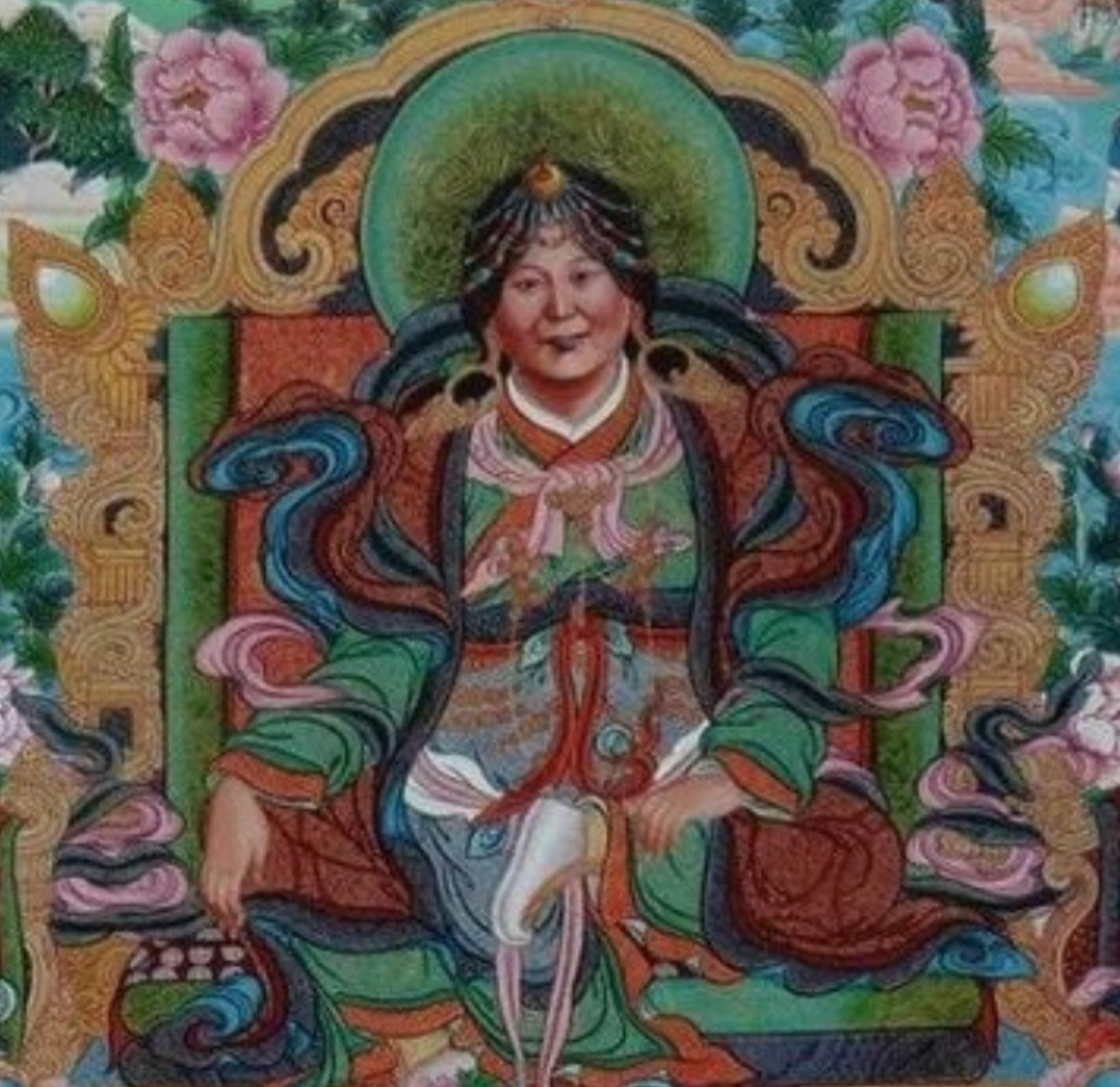
The Grandmother’s Court: Empress Trimalo and Female Authority in Imperial Tibet
By Palden Gyal
Empress Trimalo (Khri ma lod, fl. late 7th–early 8th century) stands among the most compelling political figures of the Tibetan imperial period. She was the consort of Mangsong Mangtsen (r. c. 650–676 CE) and mother of Emperor Tri Düsong (r. 676–704 CE). Our principal source for her career is the Old Tibetan Annals (PT 1288; IOL Tib J 750), among the Dunhuang manuscripts discovered in the sealed Library Cave at Mogao in the early twentieth century. The Annals is Tibet’s oldest extant historical text and arguably the most reliable source for the first half of the Tibetan Empire. It survives in two fragmentary versions: the longer ‘civil’ version I (PT 1288; IOL Tib J 750), covering 650–748, and the shorter ‘military’ version II (Or.8212/187), covering 743–765. It records events in a spare annalistic register that, precisely because it does not editorialize, makes the structural weight of Trimalo’s presence all the more legible.
Trimalo’s most consequential political role emerged after Tri Düsong’s untimely death in the winter of 704. The emperor died not in the imperial heartland but on campaign against the Mywa on the southeastern frontier where the Nanzhao Kingdom (738–859) would arise through unification some three decades later. It was this expansionist venture that left the succession exposed.
Trimalo belonged to the powerful ’Dro clan, and it was the weight of this affiliation, combined with her position as empress dowager, that allowed her to decisively shape what followed. She and her clan backed Gyel Tsukru (rgyal gtsug ru) as the legitimate heir against the elder prince Lha Belpo, whose claim was possibly undermined by the foreign origin of his mother: Queen Gatün, a consort from the ’Azha kingdom. Trimalo’s success in this struggle is indicative of a broader pattern in Tibetan dynastic and court politics, in which queen consorts drawn from the most powerful Tibetan clans such as ’Dro and Chims competed to secure the regnal line within their own lineages, making the politics of succession inseparable from the politics of clan affiliation. The Annals records that in 705–706, Dek Renpa, Khegé Donang, Nön Nangdrak, and others revolted; the insurgents were killed at Bönmo Nalatse, and the elder prince Lha Belpo was deposed from the throne. The details behind this event remain obscure, but the outcome served Trimalo’s interests entirely and concluded with the proclamation of Trizik Zhangnyen as chief minister.
From 704 onward, the Annals consistently track a separate empress [grandmother]’s court maintaining its own residence distinct from the Tsenpo’s itinerary. A stable pattern emerges: Drön in the summer months, Lhegang Tsel in winter, sustained across years of ministerial realignment and succession uncertainty. Her physical co-location with the legitimate heir Gyel Tsukru during the crisis is the clearest index of her protective and legitimating function.

Trimalo’s statecraft extended beyond the domestic succession. Around 710, she arranged a dynastic marriage alliance with the Tang, receiving Princess Jincheng (Kimshang Kongcho) as a consort for the future emperor, a diplomatic act of considerable strategic weight. The Annals records this under the year 710–711, when the princess’s traveling arrangements were made and she departed for Lhasa. Gyel Tsukru was formally enthroned as Tri Detsuktsen in 713, his name-bestowal ceremony marking his coming of age as ruler. It is presumably around this moment that Trimalo died. The Annals notes her lying-in and embalming state, followed immediately by senior ministers convening councils and taking account of the red tally of the three Horns, administrative acts whose timing signals the degree to which her presence had organized the governance of the preceding decade.
The rise of Empress Trimalo to the zenith of political authority is not an exception in Tibetan history. Her career is better understood as an early and unusually well-documented instance of a pattern that would recur across Tibetan political history: the exercise of sovereign authority by royal women operating within the recognized structures of power. It anticipated many similar figures in the post-imperial era, when the fragmentation of the Tibetan Empire produced a constellation of regional kingdoms, particularly in the eastern borderlands, in which powerful queens ruled their polities not only during periods when the formal mechanisms of succession were contested or incomplete, but also in times of relative political stability. These were not ‘regencies’ tolerated by necessity and relinquished at the first opportunity; they were sustained exercises of governance that commanded the loyalty of ministers, the administration of territory, and the management of external alliances.
The centrality of clan alliances and the importance of royal lineage, passed down through both patrilineal and matrilineal lines, appears to have been the structural foundation of this political culture. There are too many such polities to cover here: from Chakla and Muchi to Meu and Khangsar in Eastern Tibet. The Chinese chroniclers’ designation of a so-called “Eastern Queendom” in Eastern Tibet (Sumpa polities), whatever its imprecisions as an ethnographic category, registers a genuine and recurring political reality. Taken together, these cases suggest that Tibetan political culture possessed a robust, if rarely studied, recognition of female authority: not as a departure from legitimate rule, but as one of its available and accepted forms.
References
Dotson, Brandon. “Imperial Records from Dunhuang.” In Sources of Tibetan Tradition, edited by Gray Tuttle, Kurtis R. Schaeffer, and Matthew T. Kapstein. New York: Columbia University Press, 2013, pp. 48–51.
Dotson, Brandon. The Old Tibetan Annals: An Annotated Translation of Tibet’s First History. Vienna: Verlag der Österreichischen Akademie der Wissenschaften, 2009.
Kapstein, Matthew T. The Tibetans. Oxford: Blackwell, 2006, pp. 62-64.
Primary Sources
Old Tibetan Annals, Version I: Pelliot tibétain 1288, Bibliothèque nationale de France. Accessible via the International Dunhuang Project: https://idp.bl.uk/
Old Tibetan Annals, Version I: IOL Tib J 750, British Library. Accessible via the International Dunhuang Project: https://idp.bl.uk/
Old Tibetan Annals. Old Tibetan Documents Online (OTDO): https://otdo.aa-ken.jp/

Leave a Reply