By Palden Gyal
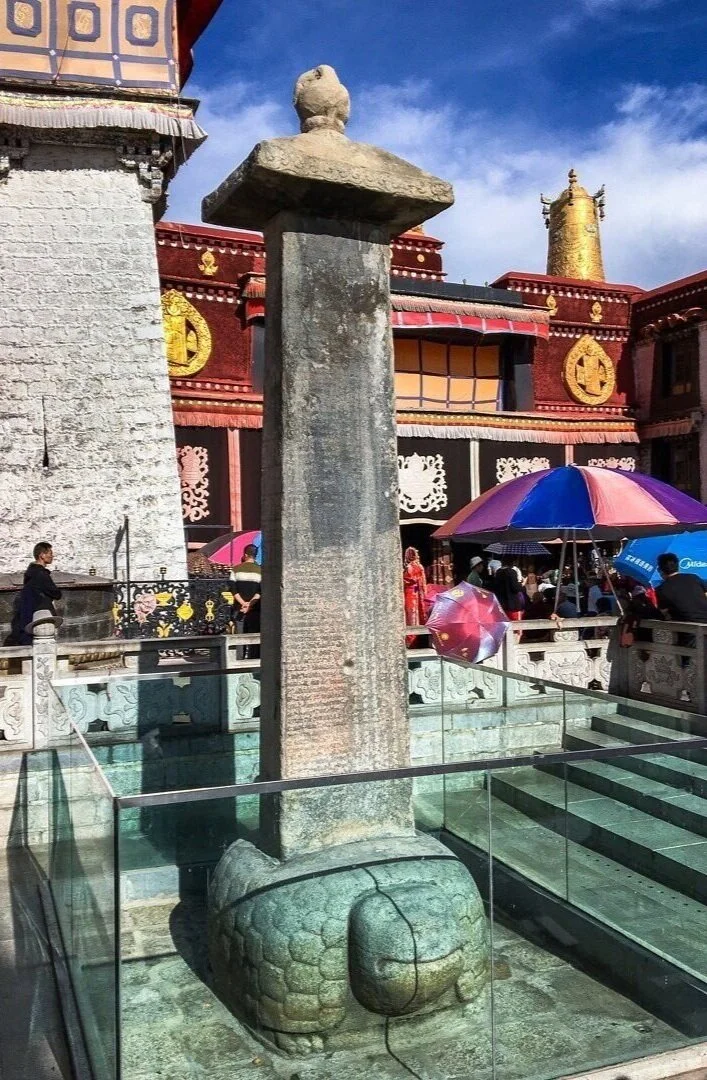
In front of the Jokhang Temple in Lhasa, one of the most sacred sites in the Tibetan world, a stone pillar has been standing for over twelve hundred years. It is not a decorative monument. It is a political document – carved in both Tibetan and Chinese, installed in the heart of the imperial capital, and addressed to anyone who would pass by and read it. The pillar records the treaty of 821/822 between the Tibetan Empire and Tang China, and it remains one of the most extensively studied bilingual primary sources from the entire imperial period.1 The Jokhang pillar is the only survivor of three. Two identical pillars bearing the same inscription were also erected: one at the Tang capital of Chang’an, and another at the border between the two empires, the location of which remains disputed.
The exact location of the border pillar remains unknown, since it has not survived the trials of time. H. E. Richardson (1978), working from prayer texts preserved in the Dunhuang manuscripts and from geographical evidence in the earlier Zhol pillar inscription (c. 764), placed it somewhere in the northeastern frontier zone between Liangzhou and Xining, where Tibetan and Tang territorial control met in the early ninth century.2 Matthew Kapstein’s later philological research identified Dega (Yutsal) in the name of the associated Treaty Temple as a Tibetan transcription of the Chinese toponym Daxia 大夏, pointing to the Linxia region of southern Gansu, where the Daxia River still carries the older name, a finding consistent with Richardson’s broader estimate.3 Chinese scholarship has proposed Chengxian county and Qingshui, both in Gansu, as further candidates. All of these hypotheses place the lost pillar within the same general zone, suggesting broad agreement on the frontier region even where the precise site remains unresolved.
The Dunhuang manuscripts also preserve textual evidence of the consecration of a temple erected at Dega Yutsal to commemorate the peace: evidence that the treaty was being marked not only in imperial stone but in active devotional practice along the frontier itself. The Chang’an pillar is presumed lost to the upheavals of the late Tang; the border pillar and the temple remain to be archaeologically confirmed. The treaty named the king of Tibet, Khri gtsug lde brtsan, better known as Ralpachen (815–841), and the Chinese emperor Muzong of the Tang dynasty (821–824). The agreement was conducted not by the rulers in person but through a large number of ministers on both sides – 18 Chinese and 17 Tibetan officials – who gathered at the Tang capital of Chang’an to swear the oath.
The agreement (ཁྲང་ཆིང་མཐུན་འབྲེལ་རྡོ་རིང་། 长庆会盟碑) it commemorates came at the end of nearly a century of conflict between two of Asia’s most powerful empires. By the early ninth century, both Tibet and Tang China were exhausted. They had fought over Central Asian trade routes, frontier territories, and political influence across a vast arc of the continent. The treaty brought that era formally to a close. Sworn at the Tang court in Chang’an in 821 and ratified at Lhasa the following year, it fixed a boundary between the two empires and set out terms for the security of envoys, merchants, and border populations on both sides. In 823, those terms were carved into stone. As Yihong Pan (1992) examines, this consequential treaty was preceded by six “sworn covenants” between the two empires between 706 and 821.4 Pan observes that the Tibetan empire was a more formidable neighbor to China because of its relative economic and cultural independence.
An important passage from the inscription reads: (lines 26–31, west face):
བོད་རྒྱ་གཉིས། ད་ལྟར་སུ་མངའ་བའི་ཡུལ་དང་མཚམས་སྲུང་ཞིང་། དེའི་ཤར་ཕྱོགས་ཐམས་ཅད་ནི་རྒྱ་ཆེན་པོའི་ཡུལ། ནུབ་ཕྱོགས་ཐམས་ཅད་ནི་ཡང་དག་པར་བོད་ཆེན་པོའི་ཡུལ་ཏེ།
bod rgya gnyis / da ltar su mnga’ ba’i yul dang mtshams srung zhing / de’i shar phyogs thams cad ni rgya chen po’i yul / nub phyogs thams cad ni yang thag par bod chen po’i yul te
Tibet and China, both guarding the countries and borders that each now holds – everything to the east of that is the country of Great China; everything to the west is, rightly, the country of Great Tibet.
What makes this passage remarkable is its grammar. The text names two empires (gnyis, two) and places them in strict parallel. The frontier runs east-west and divides the world symmetrically: rgya chen po (Great China) on one side, bod chen po (Great Tibet) on the other. Tibet is not described as a subordinate state or a frontier zone making concessions to a larger power. It appears as an equal party to a bilateral agreement, dividing the world between two sovereign realms.
Beyond its grammar, the passage makes that claim in the most durable medium available and in the most public spaces imaginable. This was not a private manuscript or a court record filed away in an archive. The same inscription was carved in stone and erected in three locations simultaneously: at the Tang capital of Chang’an, at the border between the two empires, and in front of the Jokhang, the religious heart of Lhasa. Each site addressed a different audience: the Tang court, the frontier populations who lived under the treaty’s terms, and the Tibetan world centered on its most sacred shrine. Of the three, only the Lhasa pillar survives, which means that it now carries the evidentiary weight of all three: the empire’s own terms, in the empire’s own language, with the same terms recorded in Chinese alongside, visible to every Tibetan who passes through the city.
An often quoted passage, from lines 58–64 of the same face, moves from establishing the boundary to explaining what the boundary is for:
བོད་བོད་ཡུལ་ན་སྐྱིད། རྒྱ་རྒྱ་ཡུལ་ན་སྐྱིད་པའི་སྲིད་ཆེན་པོ་སྤྱར་ནས་གཙིགས་བཅས་པ་འདི། ནམ་ཞར་མྱི་འགྱུར་བར། དཀོན་མཆོག་གསུམ་དང་། འཕགས་པའི་རྣམས་དང་། གཉི་ཟླ་དང་གཟ་སྐར་ལ་ཡང་དཔང་དུ་གསོལ་ཏེ།
bod bod yul na skyid / rgya rgya yul na skyid pa’i srid chen po spyar nas gtsigs bcas pa ‘di / nam zhar myi ‘gyur bar / dkon mchog gsum dang / ‘phags pa’i rnams dang / gnyi zla dang gza’ skar la yang dpang du gsol te /
This great treaty, established so that Tibetans shall be happy in the land of Tibet and Chinese happy in the land of China, shall never be changed. The Three Jewels, the assembly of noble ones, the sun and moon, and the planets and stars are invoked as witnesses.
The phrase bod bod yul na skyid / rgya rgya yul na skyid has earned its place as the most quoted line in the inscription because it states its purpose with complete clarity. Its parallel construction encodes equality in grammar before a single political argument has been made: two peoples, two lands, one condition: happiness and security distributed equally between them. But the passage does something the boundary declaration of lines 26–31 does not. Where that earlier passage establishes the line – this is where Tibet ends and China begins – this passage explains what the line is for. The treaty is not framed as a military settlement or a concession extracted by exhaustion. It is framed as a welfare agreement: the purpose of fixing the boundary is so that Tibetans may live well in Tibet and Chinese may live well in China. It is a remarkably generous political formula for a document produced at the end of a century of war, and it shifts the register of the whole inscription from territorial claim to something closer to a foundational statement about the proper relationship between two sovereign peoples.
The invocation of witnesses gives that statement its permanence. The Three Jewels, the assembly of arhats (noble beings), the sun and moon, the planets and stars – the witnesses move outward in scale, from the Buddhist polity to the celestial bodies that govern time itself, until nothing in the visible or invisible world has been left out. Sealed with nam zhar myi ‘gyur bar (‘shall never be changed’) – the covenant is placed beyond the reach of any future ruler who might wish to revisit it.
The pillar still stands. It has survived the collapse of the empire that built it, the political transformations of twelve centuries, and the disruptions of the twentieth century. As a bilingual document it continues to be studied by historians of Tibet, China, and early medieval Central Asia alike. It is, as Richardson recognized, not simply a record of what was agreed. It is evidence of how the Tibetan Empire understood itself: a power that negotiated with its neighbors, fixed its frontiers in durable stone, and left its own account of that history standing in front of its most sacred temple. That the stone is still there, still readable, still argued over, is its own kind of testimony – a witness to how empires fall and what they leave behind, and an enduring reminder to Tibetans that their history was written not in memory alone but in stone.
References
བོད་ཀྱི་རྡོ་རིང་ཡི་གེ་དང་དྲིལ་བུའི་ཁ་བྱང་། Bod kyi rdo ring yi ge dang dril bu’i kha byang [Tibetan Pillar Inscriptions and Bell Colophons]. Beijing: Mi rigs dpe skrun khang, 1984.
Fang-Kuei Li 李方桂. “The Inscription of the Sino-Tibetan Treaty of 821-822.” T’oung Pao 44, no. 1/3 (1956): 1–99.
Kapstein, Matthew T. 2014. “The Treaty Temple of De ga g.yu tshal: Reconsiderations” Journal of Tibetan Studies 10: 32–34.
Richardson, H. E. “The Sino-Tibetan Treaty Inscription of A.D. 821/823 at Lhasa.” Journal of the Royal Asiatic Society of Great Britain and Ireland, no. 2 (1978): 137–62.
Pan, Yihong. “The Sino-Tibetan Treaties in the Tang Dynasty.” T’oung Pao 78, no. 1/3 (1992): 116–61. http://www.jstor.org.ezproxy.cul.columbia.edu/stable/4528556.

Leave a Reply