The Chapa-Sapan Divide: A Brief Note on Buddhist Epistemology in Tibet
By Tenzin Rabga
The eleventh century saw a resurgence in Tibetan intellectual scholarship; a renaissance of Buddhist philosophical scholasticism – known as the period of ‘later dissemination’ (bstan-pa phyi-dar) – set roots on the Tibetan plateau, defining its intellectual history, as well as shaping its political destiny. This era, marked by the emergence of different sects of Tibetan Buddhism, also produced some very sharp intellectual debates between these schools. The battle for philosophical supremacy was more than just a search for the correct path to salvation; it had immediate and far-reaching consequences for the survival of the particular tradition. These socio-political implications notwithstanding, their impact on the character of philosophical critique and analysis within the Tibetan intellectual culture survives to this day.
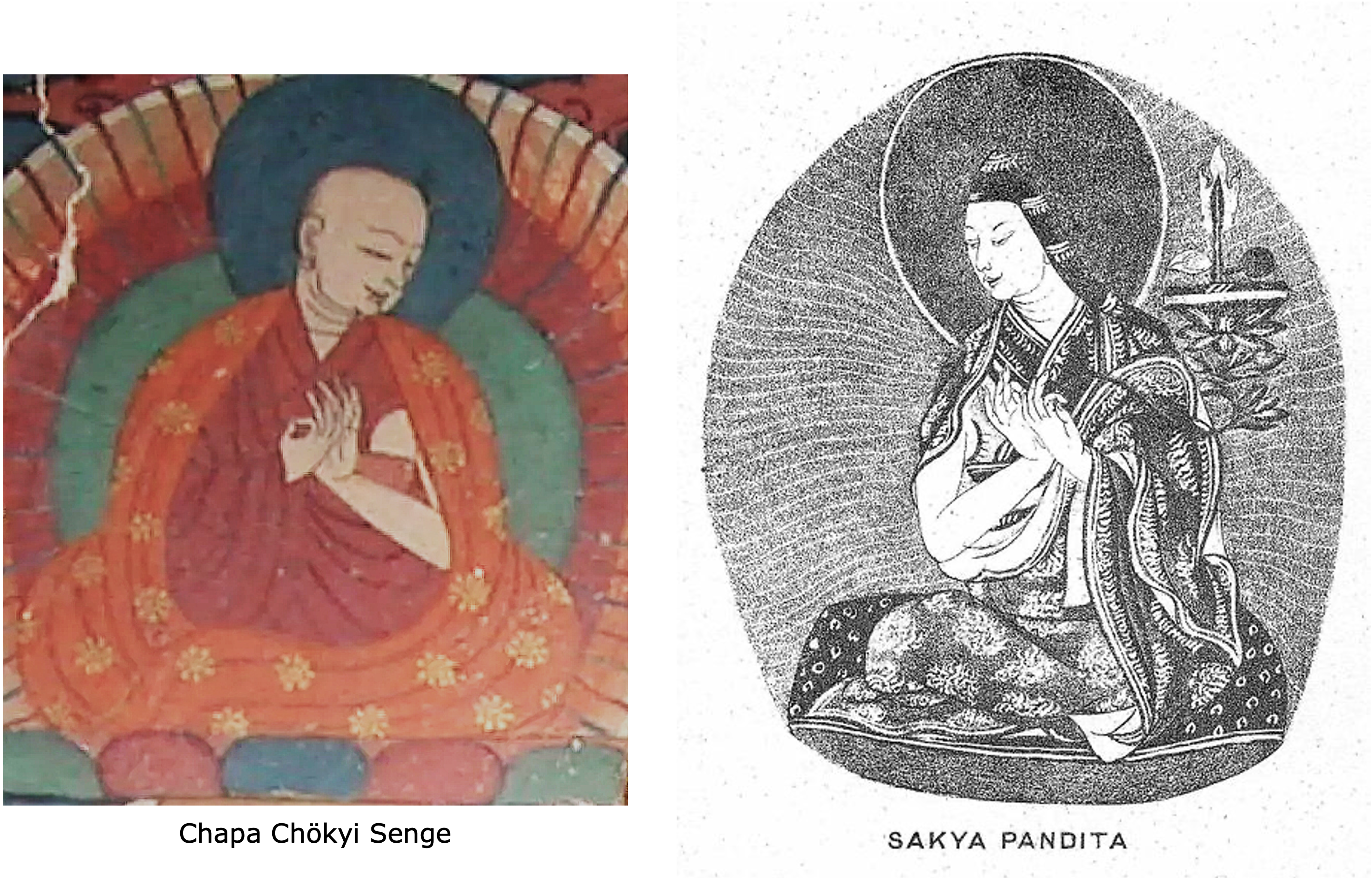
One such debate concerns key issues in Buddhist epistemology, especially pertaining to the nature of the mind – the engagement of the subject with its object. Chapa Chökyi Senge (phywa-pa chos-kyi seng-ge) (1109 – 1169 CE), a renowned Kadampa master, a prolific scholar, and the sixth abbot of the foremost Tibetan Buddhist center for learning of the time, Sangphu Neuthok (gSang phu ne’u thog) monastery, established, what came to be known as the ‘Chapa Tradition’ (phywa lugs). This school of thought would become the dominant form of Buddhist epistemology studied widely across Tibet.
It was not until Sakya Pandita Kunga Gyaltsen (sa skya pan di ta kun dga’ rgyal mtshan) (1182 – 1251 CE), popularly known as Sapan, a prominent Tibetan scholar from the Sakya lineage, that a systematic refutation of Chapa’s view would emerge, presenting a competing understanding of Acharya Dignāga’s and Dharmakīrti’s philosophies. He denounced Chapa’s presentation as straying from its original Sanskrit sources and sought to realign the Tibetan Buddhist schools with their Indian origins. As such, this debate exemplifies an important aspect of intellectual culture of Tibet at those times, contrasting the indigenous Tibetan contributions to Buddhist philosophy against the purist tendencies ensuring such native innovations stay true to their authentic Indian roots.

Born and active throughout most of the twelfth century, Chapa Chökyi Senge’s intellectual legacy is characterized by its unparalleled originality. His text on epistemology, Illuminating the Darkness of the Mind on Valid Cognition (Tshad-ma yid kyi mun-sel), is widely considered the first indigenous Tibetan scholarly work on this subject. Here, he outlines a framework for approaching epistemology through the study of the object to be apprehended, the subject that apprehends, and their interplay that leads to the rich tapestry of knowledge. He famously created and popularized the system of dialectical debate, now widely prevalent and an unalienable component of Tibetan monastic education. He is also credited with originating the ‘Collected Topics’ (bsdus grwa) genre of presenting core concepts in Buddhist metaphysics and epistemology through rigorous debate. His impact on the prevalence of the formal study of epistemology and logic in Tibet, and his scholarly contribution to the subject has rightfully earned him the title, ‘The Master of Logic’ (Rigs pa’i Wangchuk).

A little over a decade after Chapa’s passing, a boy named Palden Dhondup (dpal ldan don grub) was born to the noble Khön family, the throne holders of the Sakya lineage. Ordained as Kunga Gyaltsen (kun dga’ rgyal mtshan) by his uncle and the great Sakya scholar Jetsun Drakpa Gyalsten (rje btsun grags pa rgyal mtshan), Sapan would commence his study of the Buddhist canons under his tutelage. While he would encounter Chapa’s teachings on epistemology, it is understood that it was through his meeting with his teacher, the Indian Buddhist monk and scholar, Pandita Śākyaśribhadra (1127 – 1225 CE) that he would develop a thorough understanding of the subject. From early on, it was apparent to Sapan the need to return to the Sanskrit root texts and to preserve their original meanings. Along with his teacher, he would undertake a major revision of the Tibetan translation of Dharmakīrti’s magnum opus, Commentary on Valid Cognition (Pramānavārttika), and launch a strong refutation of the prevalent – primarily Chapa’s – exposition on this text, in his Treasury of Logic on Valid Cognition (Tshad ma rigs pa’i gter) (hereafter TLVC). A renowned polymath with an unrivaled command over Sanskrit, Sapan emerged as a towering intellectual figure of his time commensurate with the title of a Pandita bestowed upon him.

As highlighted in his ‘pledge to (complete) the composition’ of his seminal text TLVC, Sapan was acutely aware of and disillusioned by, what he perceived to be, a serious shortcoming in the prevalent Tibetan accounts of the epistemology of Dignāga and Dharmakīrti. Of the many points of contention, one that merits emphasis is the ontological status of concepts, in particular, of universals, such as the ‘generic’ pot and tree of which every pot and tree in existence are particulars of. While it is undisputed that these particular instances of pots and trees are entirely unique in their composition and distinct in their spatiotemporal locations, there is a fundamental disagreement regarding the nature of the universals – i.e., the generic tree and pot – that pervade and transcend these primary substantial entities. Sapan, on the one hand, true to Dignāga’s and Dharmakīrti’s nominalism, vehemently denied substantially existent universals; Chapa, on the other, asserted their substantial reality. So, here one finds a clear contrast between Chapa’s realism and Sapan’s strict anti-realism with regard to these universals. Naturally, Sapan argued that the Tibetans – Chapa’s followers – in reifying these concepts (universals), betray the essence of the original Indian texts (by Dignāga and Dharmakīrti). He attributes this to their failure to recognize the central role of the Apoha theory in concept formation.

To appreciate Sapan’s insistence on the role of Apoha, one must look at how our conceptual minds function. For Sapan, when we see separate instances of a tree, there is no generic tree simultaneously present in all of its particulars visible to our senses. How, then, are we able to identify all of these unique entities as particulars of a common universal class: tree? In line with Dharmakīrti, Sapan asserts that it is entirely through the process of exclusion (Apoha) that our conceptual minds engage with these objects. This mind conceives of a generic tree – a universal – by the means of exclusion of all that is not a tree and superimposes this onto each individual and unique substantially existent/real tree. In other words, there is no universal and substantially present tree that we may directly cognize without undergoing this, seemingly convoluted, process of exclusion. In contrast, Chapa and his followers comfortably assert that the generic tree is both a universal and substantially real. It is a universal since it has particulars; it is substantially real because it is subject to causality, and therefore, is a functional entity and not merely a conceptual construction. The disagreement between these two schools could not be more fundamental.
Sapan’s critique and his subsequent reformulation of how these epistemological issues ought to be addressed was so significant that it led to a bifurcation in the Tibetan Buddhist accounts of epistemology. These two schools of thought and their ideas persist to this day, and their ardent adherents continue to debate the same issues that concerned their progenitors centuries ago. However, such debates and philosophical differences were not unique to, but were characteristic of the scholarly environment of Tibet at that time; they were undoubtedly instrumental in shaping its rich intellectual diversity. Chapa’s fierce independence and Sapan’s meticulous articulation of the Sanskrit root texts laid the framework that would guide the burgeoning Buddhist scholarship following in their footsteps.
References
Dpal dge ldan pa’i tshad ma rig pa’ gzhung gces btus. 2006. Vol. 21 of Bod kyi gtsug lag gces btus. New Delhi: Institute of Tibetan Classics.
Dpal sa skya pa’i tshad ma rig pa’ gzhung gces btus. 2006. Vol. 20 of Bod kyi gtsug lag gces btus. New Delhi: Institute of Tibetan Classics.
Dunne, John. 2004. Foundations of Dharmakīrti’s Philosophy. Studies in Indian and Tibetan Buddhism. Somerville, MA: Wisdom Publications.
Gold, Jonathan C. 2007a. The Dharma’s Gatekeepers: Sakya Pandita on Buddhist Scholarship in Tibet. Albany: State University of New York Presss.
Gold, Jonathan C. “Sakya Pandita’s Anti-Realism As a Return to the Mainstream.” Philosophy East and West 64, no. 2 (2014): 360-374.
Kapstein, Mathew T. 2000. The Tibetan Assimilation of Buddhism: Conversion, Contestation, and Memory. New York: Oxford University Press.
Sakya Library. “Treasury of Logic on Valid Reasoning (Tshad ma rigs pa’i gter).” Accessed May 12, 2026. http://sakyalibrary.com/Library/Book/3a93c3d8-0bb4-44c2-9d60-cc3589292e12.
Stoltz, Jonathan. 2006. “Sakya Pandita and the Status of Concepts.” Philosophy East and West 56, no. 4 (2006): 567-582.

Leave a Reply